
Introduction
The Filters on collections feature adds Searchanise filtering and sorting to Shopify collection pages. Customers can narrow down collection products by price, availability, vendor, product type, product options, metafields, and other attributes.
Searchanise provides filters for common product attributes by default. You can also create additional filters and organize them into different filter trees for specific collections.
Example of a collection page with Filters on collections:
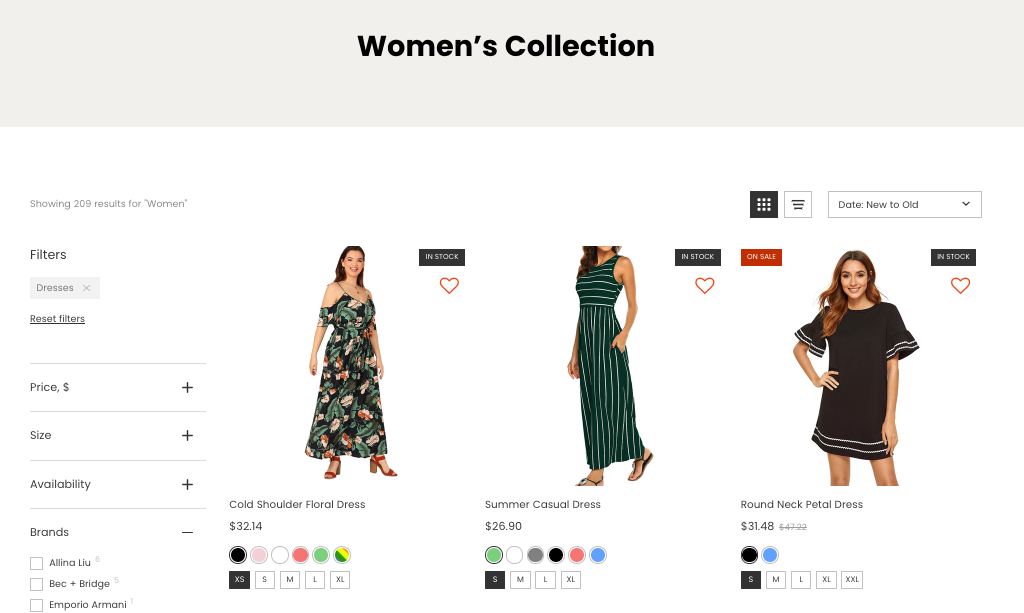
Searchanise Search & Filter is gradually rolling out a new control panel to Shopify stores. During the rollout, some Shopify stores may still use the previous version. If switching is available for your store, you can try the new control panel and return to the previous version at any time. Learn how to identify your control panel version.
Choosing a setup method
Searchanise supports two ways to add filters to collection pages:
- Via redirect – collection links open the Searchanise Search results page with the corresponding collection applied.
- Via theme/code editor – Searchanise replaces the product grid directly on the collection page, so the original collection URL remains unchanged.
For most Online Store 2.0 themes, we recommend using the theme editor and adding the Searchanise section. Editing theme code should be used only when the section cannot be added through the theme editor.
Enabling Filters on collections
Previous admin
- Go to Filters > Filters on collections > Settings.
- Select one of the following options:
- Navigation through redirecting Shopify collection links
- Navigation through embedding HTML into the Shopify template
- Configure the collection sorting and SEO settings if necessary.
- Apply the changes.
- Open Collection filter trees and configure the filters you want to display.
New admin
- Go to Filters > Filters on collections > Settings.
- Turn on Filters on collections.
- Select one of the following setup methods:
- Via redirect
- Via theme/code editor
- Configure the collection sorting and SEO settings if necessary.
- Click Save.
- Go to Collection filter trees and configure the filters you want to display.
Setting up Filters on collections via redirect
With this method, Searchanise replaces collection links with links to the Search results page containing the corresponding collection parameter.
Because the links are replaced after the app scripts load, visitors may briefly see the original collection URL. To reduce this delay, follow the guide on speeding up Searchanise script loading.
Previous admin
- Go to Filters > Filters on collections > Settings.
- Select Navigation through redirecting Shopify collection links.
- Apply the changes.
- Open a collection from your storefront and verify the result.
New admin
- Go to Filters > Filters on collections > Settings.
- Turn on Filters on collections.
- Select Via redirect.
- Click Save.
- Open a collection from your storefront and verify that its products, filters, sorting options, title, and URL are displayed correctly.
Excluding a collection link
To prevent a particular collection link from being redirected, add the snize-exclude-link class to that link in your theme.
This method excludes only the modified link. Other links leading to the same collection may still be redirected.
Hiding Search Results Title
To hide the Search Results title on the collection pages and display your collection titles, follow these steps:
- Go to Shopify admin panel > Online store > Themes.
- Find the theme you want to edit, and then click “…” > Edit code.
- In the Templates directory, click page.liquid.Important info
If your theme is Online Store 2.0 (Dawn, next-generation themes), it has a different structure. In this case:
- Click page.json in the Templates directory
- Find the page’s main section name in the type attribute:
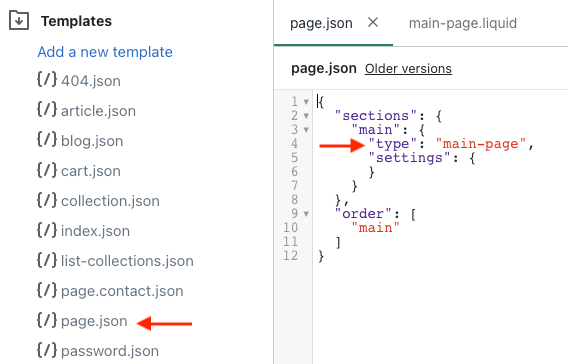
- Open the file with the found name in the Sections directory. In the example above it’s main-page.liquid
- Find the line with the page title:
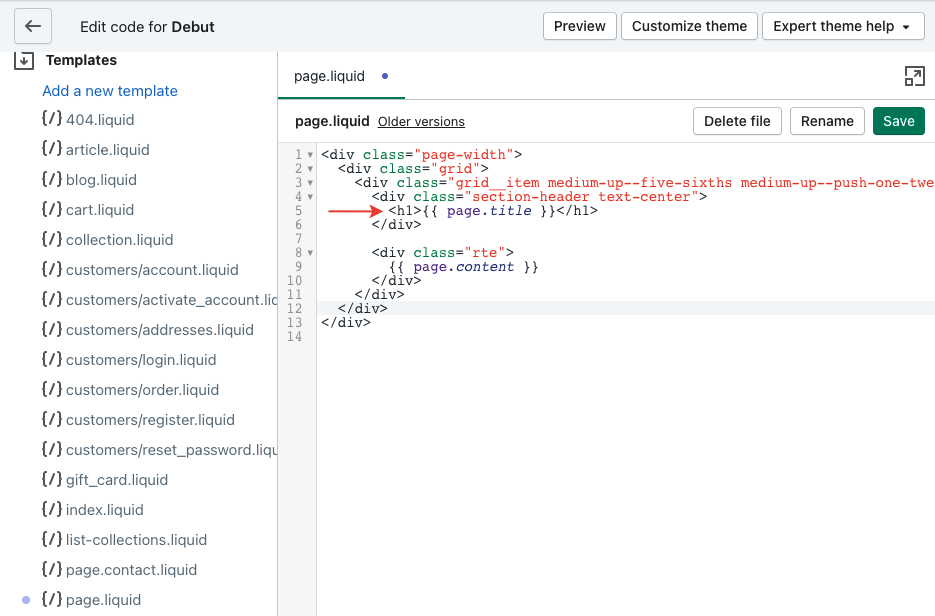
- Add snize-search-results-page-title CSS class to the element that contains the page title:
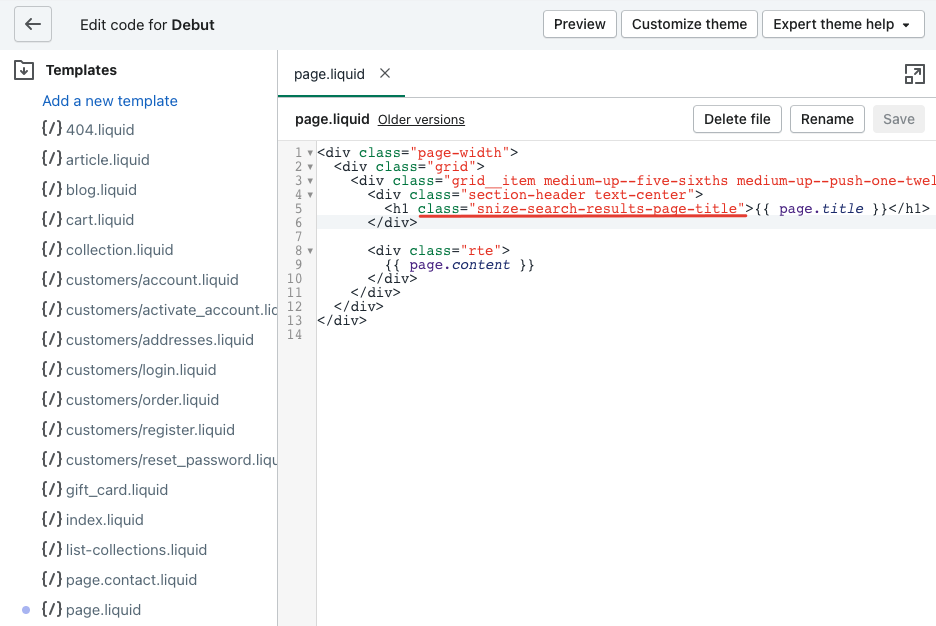
- Save the changes.
Setting up Filters on collections via theme or code editor
This method keeps the original Shopify collection URL and displays the Searchanise product list directly on the collection page.
Below you can find the instructions for Vintage and Online Store 2.0 (Dawn, next-generation themes) themes:
Disabling Filters on collections
If you added a Searchanise section or modified the theme code, remove or disable that integration before turning off the feature.
Previous admin
- If you modified the collection template, restore its original code.
- Go to Filters > Filters on collections > Settings.
- Select No navigation.
- Apply the changes.
- Check a collection page and confirm the original Shopify product grid displays.
New admin
- If you used the theme editor, disable or remove the Searchanise section from the collection template.
- If you edited the theme code, restore the original collection template.
- Go to Filters > Filters on collections > Settings.
- Turn off Filters on collections.
- Click Save.
- Check a collection page and verify that the original Shopify product grid is displayed.
Settings
These settings are available under Filters > Filters on collections > Settings.
| Setting | Description |
|---|---|
| Sorting | |
| Collection sorting rule | Changes the default collection sorting, either as specified in Shopify settings or selected separately for Searchanise. |
| Show out-of-stock products at the end of list for Manual sorting / Shopify sorting | Moves out-of-stock products to the end of the product list when Manual sorting or Shopify sorting is selected. |
| Show out-of-stock products at the end of list for Searchanise sorting | Moves out-of-stock products to the end of the product list when a Searchanise sorting option is selected |
| SEO | |
| Include collection part in product URL | Includes the collection’s handle in the product URL, for example, your_store.com/collections/watches/products/watch_1. The setting is enabled by default. |
| Override collection SEO information | Overrides your store’s page titles and meta descriptions with the Searchanise SEO settings: Searchanise Search & Filter control panel > Translations & Texts section > Search Results Widget tab > SEO part. The setting is disabled by default. If it is disabled, it will use SEO data adjusted in Shopify. |
